 Preparation
It is the goal of the following procedure to minimize the
time needed.
Turn large stovetop element on high
The element should be heating as the boiling pot is being filled.
If the phone rings or other distraction arises,
you must turn off the stove before answering.
Turn sink to full hot
To start with the hottest possible water,
wait for hot water to flow
(use cold water in regions with limited water supplies).
Fill the boiling pot with about one gallon for each STPU,
and place on the heating stovetop element.
Inspect tea bag(s)
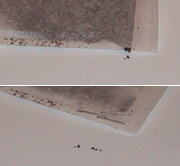 Lipton quality control is less than perfect.
DW has bought boxes where every single tea bag
leaked from the same corner (see example).
Use a stapler to correct this manufacturing defect.
(DW accepts staples for repair purposes but not as
the primary method of bag closure).
Lipton quality control is less than perfect.
DW has bought boxes where every single tea bag
leaked from the same corner (see example).
Use a stapler to correct this manufacturing defect.
(DW accepts staples for repair purposes but not as
the primary method of bag closure).
Boil tea bag
 Put one tea bag, for each STPU, into the boiling pot.
Measure sugar into pitchers
Measure 3/4 cup of sugar into each pitcher
(two pitchers for each STPU).
Watch tea pot
If you are bored before boiling, you may lift the tea bag
out of the solution by a corner and watch the streams of tea
dissolve.
While it may seem awhile, boiling will not take too long, so
do not leave unattended.
Boil for a little while
After the tea has vigorously boiled for a
minute or two most of the tea will have been
extracted and all the bad boys will be dead.
Turn off heating element
The tea solution will stop boiling in a short while.
Discard tea bag
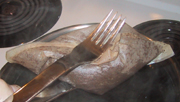 Use the spoon to lift a corner of the tea bag above the surface.
The paper corner will be cool enough to lift the bag out of the tea.
Place the bag on the spoon just above the surface
(so it does not splash if you drop it).
With the other spoon or fork, lightly squeeze the bag over the pot.
This is primarily done to prevent the bag from dripping
as it is walked to the trash receptacle and secondarily
for tea recovery.
Make sure not to squeeze so hard that the tea bag breaks.
Use the spoon to lift a corner of the tea bag above the surface.
The paper corner will be cool enough to lift the bag out of the tea.
Place the bag on the spoon just above the surface
(so it does not splash if you drop it).
With the other spoon or fork, lightly squeeze the bag over the pot.
This is primarily done to prevent the bag from dripping
as it is walked to the trash receptacle and secondarily
for tea recovery.
Make sure not to squeeze so hard that the tea bag breaks.
Separate into pitchers
 If possible, put the sugared pitchers into the sink so
they are lower and to catch spills.
Pour the tea solution into the pitchers so that they are
at equal levels (the clear containers make this easier).
Avoid pouring so fast that the
tea splashes out of the pitchers.
Use the pot handles being careful
not to touch the hot pot.
Rinse empty boiling pot with cold water.
If possible, put the sugared pitchers into the sink so
they are lower and to catch spills.
Pour the tea solution into the pitchers so that they are
at equal levels (the clear containers make this easier).
Avoid pouring so fast that the
tea splashes out of the pitchers.
Use the pot handles being careful
not to touch the hot pot.
Rinse empty boiling pot with cold water.
Dilute to proper concentration
 Using cold water, fill the pitchers to their fill lines.
Stir while filling or afterwards.
See hardware for instructions on
marking the pitcher fill lines.
Using cold water, fill the pitchers to their fill lines.
Stir while filling or afterwards.
See hardware for instructions on
marking the pitcher fill lines.
This is your major adjustment.
If you like your tea stronger (or will drink it before it
cools and ages), reduce the level of dilution.
DW believes that 3/4 cup of sugar per half a tea bag
(2/3 cup for unlemoned) is the proper ratio of sugar to tea.
Reducing the water strengthens both the sugar and tea
equally, keeping them in balance.
DW prefers "thirst quenching" tea which uses a more dilute formulation.
Restaurants often serve strong super sweet tea which has a significantly
different character.
Cool to room temperature
 To save energy
the tea is first aged and cooled outside the refrigerator.
Use a kitchen counter, window sill, garage, screened porch,
or other insect restricted space.
Cooling takes a few hours.
To save energy
the tea is first aged and cooled outside the refrigerator.
Use a kitchen counter, window sill, garage, screened porch,
or other insect restricted space.
Cooling takes a few hours.
Move to refrigerator
After the sweet tea has reached room temperature,
place it in the refrigerator for final aging and
cooling to serving temperature.
Again
It is time to make another STPU when you begin using
the last pitcher.
Serving (next page)
Table of Contents
Last update 01/04/2004